Almost everyone has done it. The day ends, you finally have a moment to yourself, and instead of sleeping you stay up scrolling long past the point of being tired. You are not confused about the time and nothing is stopping you from putting the phone down. You just do not want the day to be over yet.
This guide explains what revenge bedtime procrastination actually is, why the pattern is so hard to break, how to recognise it in yourself, and how to reclaim your evenings without sacrificing your sleep.
What is revenge bedtime procrastination?
Revenge bedtime procrastination is delaying sleep on purpose to reclaim the leisure or autonomy you did not get during a packed day - even at the cost of being tired the next morning. The "revenge" is against a schedule that left no room for you. If your whole day was spoken for by work, commuting, chores, and other people's needs, staying up late can feel like the only way to take some time back.
It helps to be clear about what this is and is not. It is a widely described modern habit, not a personal flaw and not a medical diagnosis. Plenty of otherwise disciplined people do it. Naming the behaviour matters, because once you see it as a predictable response to how your day is structured, the fix stops being "try harder to sleep" and becomes "change the conditions that make you want to stay up."
Why you do it
The pattern is not really about being bad at sleeping. A few forces stack up at the end of the day and push you toward the phone:
- Your day had no slack. When every hour is claimed by obligations, there is no built-in "me time" - so the need for it does not disappear, it just gets pushed to the only place it can go.
- Night is the only unclaimed time. Once the house is quiet and nobody needs anything from you, those hours feel like the only ones you actually own. Giving them up to sleep can feel like giving up the last bit of freedom in your day.
- Self-control is lowest when you are tired. The part of you that plans and resists is running on empty by late evening, exactly when you are asking it to make a hard choice.
- The phone is the easiest reward available. It is right there, it is endless, and it delivers a small hit of novelty on demand - far less effort than reading, stretching, or anything that would actually help you wind down.
Put those together and staying up is not irrational at all. It is a tired brain reaching for the cheapest available reward at the one time of day that feels free. That is why the classic advice to "just go to bed" so rarely works, and why the same pull shows up as late-night doomscrolling night after night.
The signs
Revenge bedtime procrastination looks a little different from ordinary insomnia. A few tells:
- You stay up with no real reason - you are not working, not waiting on anything, just not going to bed.
- You feel like you "deserve" more evening, as if the day owes you time you did not get.
- You regret it in the morning and promise yourself tonight will be different.
- There is no external cause of the delay - it is a choice you keep making, not a noise or a worry keeping you up.
If most of those sound familiar, you are almost certainly delaying sleep on purpose rather than struggling to fall asleep. That is good news, because it means the levers you can pull are behavioural.
How to reclaim your nights
The goal is not to white-knuckle your way to bed. It is to remove the reason you want to stay up, and to make the healthy choice the easy one. Four moves that work together:
- Protect real me-time during the day. If you get even a small pocket of genuinely unclaimed time earlier - a proper lunch break, a walk, twenty minutes with a book - the night no longer has to carry all of it. The urge to stay up shrinks when the day is not a total loss.
- Build a wind-down ritual you look forward to. The evening does not have to be a punishment that ends in sleep. Give yourself something calming you genuinely enjoy - a warm shower, a few pages, a bit of quiet - so bedtime feels like a reward rather than the end of your freedom.
- Reduce friction to sleep, increase friction to scroll. Put the phone across the room so reaching for it takes effort, and block the distracting apps during your sleep window so the feed simply is not an option. When the easy path is winding down, that is the path you take. This is the core of breaking the nighttime phone habit.
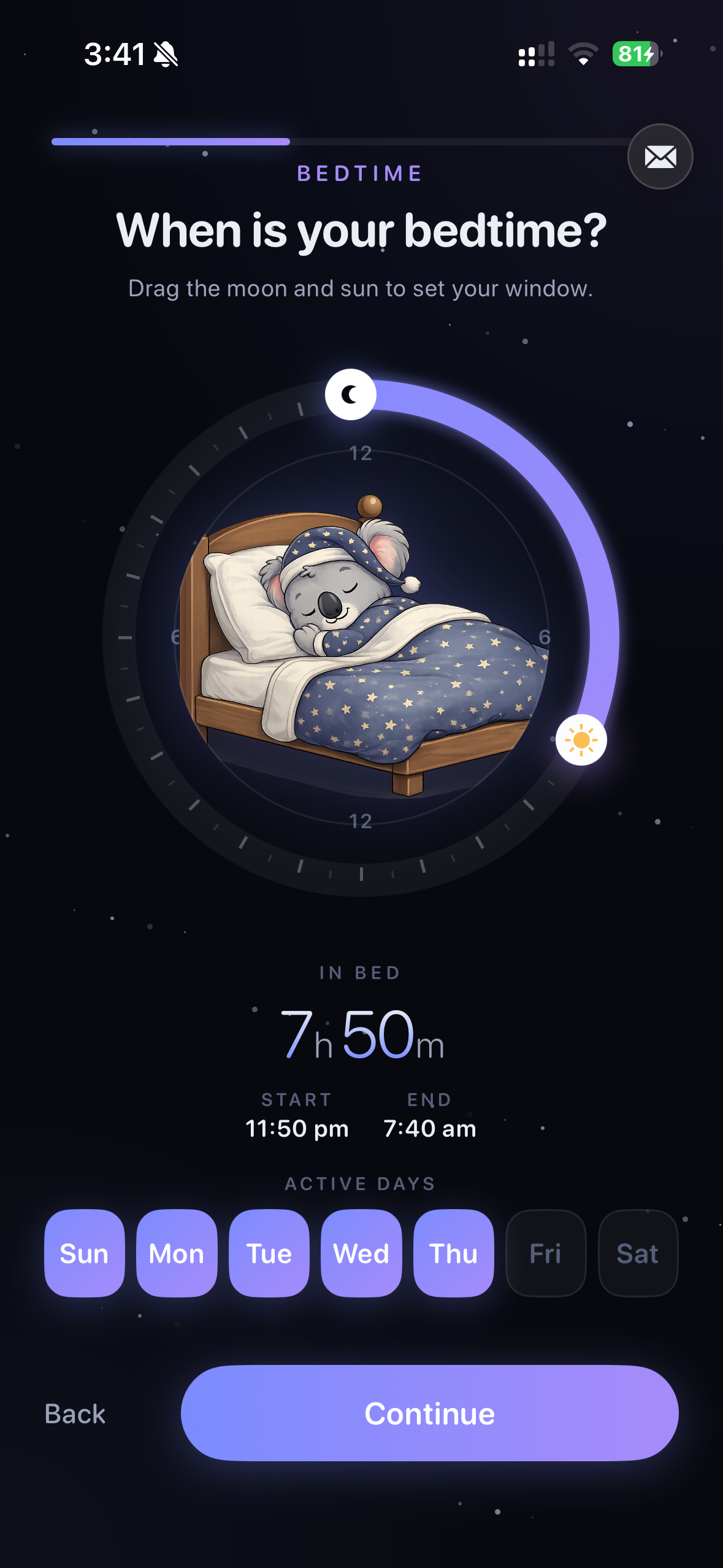
- Set and honor a consistent sleep window. Going to bed and waking around the same time steadies your body clock and turns bedtime into a boundary rather than a nightly negotiation. Decide the window once, then defend it.
How Malko helps you stop the 1am scroll
Malko is built for exactly this pattern. You set your sleep window once, and every night Malko locks the distracting apps - social, video, news, games - during that window. So when 1am rolls around and you reach for the phone to claim a little more evening, the feed simply is not there. The default at bedtime becomes winding down, not scrolling, without you having to decide it again every night.
Instead of leaving you with nothing, Malko offers timed wind-down activities - breathing, a short meditation, sleep reading, journaling - so you still get the me-time reward, just in a form that helps you sleep rather than one that steals the night. And because the pull is strongest when your willpower is lowest, Malko uses a gentle 3-strikes escalation: a warm nudge on strike one, a second ask on strike two, and it holds the line on strike three. Gentle first, firm when needed. It all runs on-device through Apple Screen Time, so nothing about your nights ever leaves your phone.
Get Malko free on the App StoreGive it a week
You will not undo years of late nights in a single evening, and you do not need to. The point is to change the setup so the pull weakens on its own. Protect a little daytime for yourself, make bedtime something you enjoy, and put the scroll out of reach when your willpower is at its thinnest. Do that consistently and most people find the 1am scroll loosens its grip in about a week - not because they got more disciplined, but because they stopped fighting the same battle every night. If you want to compare the tools that make it stick, here is a rundown of the best bedtime app blockers.
Frequently asked questions
What is revenge bedtime procrastination?
Revenge bedtime procrastination is delaying sleep on purpose to reclaim some leisure or personal time you did not get during a busy day, even though you are tired and know you will pay for it in the morning. It is a widely described modern habit, not a personal flaw.
Why can't I stop scrolling even when I am tired?
Late at night is often the only unclaimed time you have, so scrolling feels like the me-time and autonomy your day never gave you. On top of that, self-control is lowest when you are tired, and the phone is the easiest reward within reach. Together that makes putting it down genuinely hard.
How do I stop revenge bedtime procrastination?
Protect real me-time earlier in the day so the night does not have to carry it, build a wind-down ritual you actually look forward to, and make the scroll harder to reach by putting your phone away and blocking distracting apps during your sleep window.
Learn more: how to stop looking at your phone at nightCan an app help with bedtime procrastination?
Yes. Malko locks the distracting apps during your chosen sleep window, so the default at bedtime is winding down instead of scrolling. It also offers timed wind-down activities that give you a small reward in a form that helps you sleep, and a gentle 3-strikes escalation that stays warm first and firm when needed.
Learn more: the best bedtime app blocker for iPhone
Reclaim your nights, not at the cost of your sleep.
Malko locks the apps that keep you up and gives you a wind-down worth looking forward to - gently, every single night.
Download on the App Store